Q4 is when touring, club nights, and fan conventions cluster — and for anyone selling merch at those events, the table budget has to work harder than it does any other quarter. Enamel pins are usually the item that does the most work per dollar: small enough to ship in volume, cheap enough to be an impulse buy, and collectible enough that people come back for the next one.
This guide covers how to design pins that sell at a merch table, how to size a run for touring versus giveaways, and how to time production around fixed event dates.
Why Pins Carry the Merch Table
The price point clears the impulse threshold. A pin sits in the range where a fan decides in a few seconds, without comparing it to the cost of a shirt or a vinyl.
They weigh almost nothing. Shipping and carrying costs are a fraction of apparel, which matters if you are touring with stock or mailing orders after the show.
They are collectible by design. Unlike a shirt, a pin invites a series — a different one per tour, per album, per city, per year. Each release creates a reason for the same fan to buy again.
They travel as fan identity. Pins go on jackets, bags, and lanyards where other fans can see them. That is free, distributed advertising that a poster or a sticker does not get.
Match the Pin to Your Audience
Bands and touring artists. The reliable structure is one core tour pin plus a small set of limited variants. A strong outline of the logo, a lyric fragment, or a tour-date mark all read clearly at the size of a thumbnail. Our guide to designing custom enamel pins covers how to simplify artwork so it stays legible once it is shrunk down.
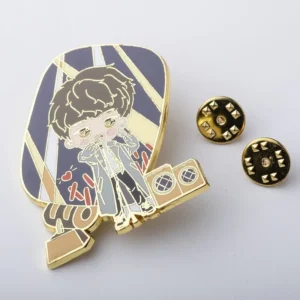
DJs, producers, and club nights. This audience responds to artwork over lettering, and often to a recurring visual signature rather than a single image. A character-led design built around a resident DJ’s identity gives a night a mascot that can be reused across lineups — which is the approach behind the DJ boy enamel pin.
Gaming, hobby, and community groups. Player communities buy pins the way they buy dice. A design that nods to the game’s iconography without reproducing licensed assets sells steadily at conventions and through community stores — the DnD dragon dice D20 enamel pin is a working example of that balance.
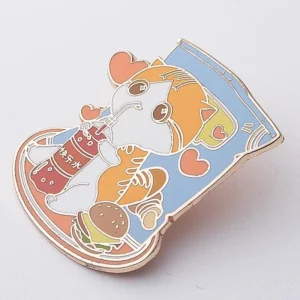
Illustrators and small merch brands. If your audience follows you for your art, the pin is the cheapest way to sell a piece of it. A cute, character-driven design with strong colour reads well in a photo and travels through social sharing — see the cat and snack enamel pin for how a simple scene holds up at pin scale. For how this plays out when a small brand builds a whole merch line rather than a single item, our small business branding pins guide covers the wider set.
Design Decisions That Move Merch
Enamel type. Soft enamel lets the metal outline sit proud of the colour, which gives a slightly textured, classic merch look. Hard enamel is polished flat, which reads more premium and resists wear better for something carried daily. Our enamel versus hard enamel comparison breaks down where each one earns its cost.
Shape. A custom outline is what makes a pin look like a designed object rather than a badge. At pin scale, silhouette does more work than internal detail.
Colour count. Colour is the main cost lever in a pin. Deciding which two or three colours carry the design, and letting the metal do the rest, keeps unit cost down without hurting the look.
Backing hardware. A rubber clutch is the default; a locking pin back or a magnetic back is worth the upgrade on higher-priced limited runs. It is the first thing a buyer notices when they open the card.
Backing card. A printed card with your name, a release date, or a numbered edition turns a loose pin into a collectible. For limited runs, numbering is what drives the secondary demand.
Packaging for shipping. If you are mailing orders after a tour, a padded envelope with a rigid card insert prevents bent pins — the most common complaint on merch orders.
Sizing the Run: Selling versus Giving Away
Two different jobs need two different quantities.
For sale at events, the run size should follow what you can realistically move per night multiplied by the number of dates, and it should be conservative on any single design. Selling out is a better outcome than carrying stock.
For promotion and street teams, the logic flips — the pin is a cost of acquisition, so quantity matters more than finish, and a simpler design at a lower unit cost is the right call.
Most artists run both: a higher-finish, smaller run for sale, plus a simpler, larger run for giveaways and press.
Timing Around Fixed Dates
Tour dates and conventions do not move, so the production schedule has to be built backwards from the event. Allow time for:
- Design and proofing. You will approve a digital mockup before production starts. Artwork in vector form (AI, PDF, or SVG) removes the biggest source of delay.
- Sample approval. Confirm enamel type, plating colour, and hardware before the full run.
- Production. The clock starts after artwork approval and scales with quantity, colour count, and complexity.
- Delivery. Allow extra time if pins ship to a venue on the road rather than to a home address.
Autumn is a busy production window for everyone ordering merch for the same season, so earlier orders get more scheduling flexibility.
What to Put in Your Brief
- Vector artwork (AI, PDF, or SVG), plus any alternate colourways you want quoted
- Shape and size, or a pin you want to match
- Enamel type: soft or hard
- Plating: gold, silver, black nickel, antique, or two-tone
- Backing: rubber clutch, locking, or magnetic
- Backing card: plain, printed, or numbered edition
- Quantity per design and the date you need them in hand
Every order from our factory includes design support and digital proofs, so you can approve the pin before it is produced.
FAQ
What is the minimum order quantity for custom pins? MOQs vary with design, size, and finish. Send us your design and quantity and we will confirm what is possible.
Can you produce a limited, numbered edition? Yes. Numbered backing cards and small limited runs are both available — tell us the edition size when you order.
How many colours should I use? As few as the design allows. Colour count is the main cost driver, and letting the metal outline carry detail usually looks better at pin scale anyway.
How long does production take? It varies with quantity, colour count, and complexity, and it starts after artwork approval. Send us your tour or event date and we will plan backwards from it.
Can each pin in a set be a different design? Yes. Mixed-design sets are common for tour runs and convention drops — send each design as a separate file.
We have never ordered custom pins before. Where do we start? Send your artwork, a rough quantity, and your event date. You will get a free digital mockup before any production commitment.
Ready to Order Your Merch Pins?
Event dates do not move, so the production window is the thing to protect. Email our design team at a48175901@gmail.com with your artwork, quantity, and event date for a free mockup and quote — we will map the timeline backwards from your date.