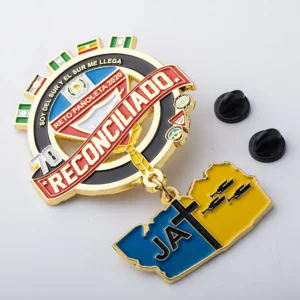
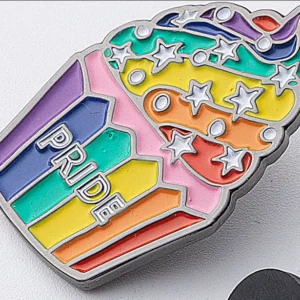
If you are sourcing custom pins for the first time, the questions that matter are not about design. They are about MOQ, what a factory needs from you, how many rounds of proofing are normal, and what actually happens between “yes, let’s do it” and a box arriving at your door.
This guide walks through the real sequence of a custom pin order placed with a manufacturer in China — written for buyers placing a first or second order, not for sourcing professionals who already know the process.
What MOQ really means in pin manufacturing
MOQ is short for minimum order quantity. In custom enamel pins, it is the smallest number a factory will run because the setup work — creating a mold or die, mixing enamel colors, plating, and running a production line — is the same whether you make 100 pins or 10,000.
Our standard MOQ is 100 pieces per design. Below that number, the per-unit cost stops making sense: the mold and setup costs get spread over too few units, and the price per pin climbs sharply. Above it, unit price drops in steps as quantity increases.
Two practical points most buyers do not hear until later:
- MOQ is per design, not per order. If you need three different pin designs, that is three setup runs. Ask for a combined quote rather than assuming the total quantity matters.
- Mixing products can help. A single order that combines pins with keychains or coins can sometimes be scheduled together, which is worth asking about before you split the order.
If your quantity is genuinely below 100 pieces — for a small event, a test run, or a single team — say so up front. A factory that can be honest about this early saves you a wasted round of emails.
Three choices that move the price more than anything else
Before you ask for a quote, it helps to know which decisions actually change the number. In custom pins, three do most of the work.
Pin type. Soft enamel leaves the metal ridges raised and the color recessed; it is the most common choice and the most economical. Hard enamel is polished flat, which gives a smoother surface and a more premium feel at a higher unit cost. Die-struck pins skip enamel entirely and rely on raised metal — the right answer for logos that read better in relief than in color. If you have no strong preference, soft enamel pins are the sensible default for a first order.
Size. Price scales with surface area, not just quantity. A jump from 25mm to 38mm is roughly a 2.3× increase in area, and the quote will reflect it. If your artwork is detailed, going slightly larger is often cheaper than simplifying the design to fit a small pin.
Plating and color count. Each additional enamel color adds a production step. Elaborate metal finishes — antique brass, two-tone plating, epoxy coating — add cost and lead time. A design that looks refined in one metal color is usually a better commercial decision than one that needs four.
The same logic applies across product types. If your project also needs custom metal keychains or challenge coins, the setup economics are similar, and combining them in one order is worth asking about.
Step 1: Send artwork and specifications in one message
The single biggest cause of slow quotes is an incomplete first message. A factory can price an order in one pass if your message contains:
Artwork
- A vector file where possible:
.ai,.eps,.pdf, or.svg - High-resolution raster at 300 DPI minimum if vector is not available (
.png,.jpg) - Clear indication of which colors are part of the design and which are background
Specifications
- Pin size in millimeters or inches (width and height)
- Quantity per design
- Pin type: soft enamel, hard enamel, or die-struck
- Metal finish: gold, silver, black nickel, copper, antique finishes, or no preference
- Backing: butterfly clutch, rubber clutch, magnetic, safety pin, or custom backing card
- Packaging: individual poly bag, backing card, box, or bulk
- Deadline and destination country
If you do not know some of these, that is normal — write “no preference, please advise” rather than guessing. The one item worth deciding early is the deadline and destination, because they determine whether the schedule is realistic at all.
Step 2: Digital proof, then a physical sample
After the quote and confirmation, the factory produces a digital proof — a rendered image of your pin with colors, plating, and dimensions applied. This is your checkpoint. Read it carefully: colors shift between screen and enamel, small text may need enlarging, and thin lines may need thickening to survive the mold.
Ask for changes at this stage, not after production starts. Proof revision rounds are normal; production changes are not.
A physical sample is a separate step. Some factories include one, some charge for it, and some skip it for simple designs. For a first order, a physical sample is worth the cost — it tells you what the enamel fill actually looks like, how the plating reads in daylight, and whether the pin weight feels substantial. Confirm with your supplier whether a sample is included and how long it adds before you commit to a deadline.
Step 3: Understand how the price is built
Custom pin pricing is not a single number. It is a stack:
| Cost element | What drives it |
|---|---|
| Mold / die fee | One-time, per design; usually not repeated on reorders |
| Unit price | Quantity, size, number of enamel colors, plating type |
| Sample fee | Often credited against the bulk order — ask |
| Packaging | Poly bag is standard; backing cards or boxes add cost |
| Shipping | Weight, destination, and speed; air vs sea |
Two things to watch when comparing quotes:
- Is the mold fee included or added later? A low unit price with an unmentioned setup fee is not a lower price.
- Is shipping door-to-door or to a port? A quote that stops at the port leaves you arranging customs clearance yourself.
Ask for the total landed cost to your address. That is the only number you can compare across suppliers.
Step 4: Payment and order confirmation
Most Chinese manufacturers work on a deposit-and-balance structure: a percentage up front to start production, the remainder before shipment. The exact split varies by supplier and order size, and it is a normal thing to negotiate.
Before paying, confirm in writing:
- Final quantity and unit price
- Mold fee and whether it is one-time
- Production schedule with dates, not just durations
- Who pays shipping, and to which address
- What happens if the delivered goods do not match the approved proof
Keep the approved proof file. It is the reference document if anything is disputed later.
Step 5: Production, quality check and shipping
Production runs in stages: mold creation, stamping or die-casting, enamel filling and baking, polishing, plating, then attachment of backings. Each stage has its own failure mode, which is why a pre-shipment check matters more than a promise.
Ask for photos of the finished batch before it ships — a straightforward request that most suppliers honor. Look for: color accuracy against the proof, plating evenness on edges, enamel depth consistency, and whether the backings are attached straight.
Shipping options, in broad terms:
- Air express (courier): fastest, highest cost per kilogram, best for tight deadlines and small batches
- Air freight: middle ground; needs airport-to-door handling
- Sea freight: lowest cost per kilogram, longest transit; only sensible for large orders planned well ahead
For a first order of a few hundred pins, air express is usually the practical choice. For a reorder of several thousand planned a season ahead, sea freight changes the unit economics meaningfully.
Common mistakes buyers make on a first order
- Sending a screenshot instead of a file. A low-resolution image forces the factory to redraw your artwork, which introduces errors.
- Deciding the deadline after the quote. Timing drives the shipping method, which drives the total cost. Decide both together.
- Skipping the proof review. Every production defect that could have been caught on a proof costs more to fix after manufacturing.
- Comparing unit prices across different specifications. A 25mm soft enamel pin and a 38mm hard enamel pin with two plating colors are not the same product.
- Not asking who handles customs. Duties and import handling are the most common surprise on a first international order.
FAQ
Do I need to order exactly 100 pieces? 100 pieces per design is our minimum. Larger quantities reduce unit cost; smaller quantities are sometimes possible for samples or repeat clients — ask before assuming.
Can you work from a hand-drawn sketch? Yes. A clear sketch with color notes is enough to start. We will redraw it as vector artwork and send it back for your approval before anything is produced.
How long does the whole process take? It depends on quantity, plating, and shipping method, and it varies by season. We confirm a specific schedule with your quote rather than quoting a generic number — and if your deadline is tight, tell us first, because that changes what we recommend.
What if I need several different designs? Each design has its own mold and setup. Send all designs in one message so they can be quoted and scheduled together.
Can you match a specific Pantone color? Yes, with a Pantone reference. Without one, we match from your artwork file and confirm on the proof.
Do you ship to my country? We ship internationally and quote door-to-door where possible. Tell us the destination country and postcode with your first message so shipping is included in the quote.
Get a quote for your pins
Send us your artwork, quantity, size and deadline — we will reply within 24 hours with a real price, not a range.
- Email artwork: a48175901@gmail.com
- WhatsApp: +86 138 1790 4669
- Or use the quote form: /contact/
If you are still deciding on the product itself, start with our guides to custom enamel pins, custom medals, custom keychains and challenge coins.