October through November is marathon season across North America and Europe — and for race organizers, that means medal orders are being locked in right now. The finisher medal is the one object every single participant takes home, wears for hours, and photographs more than anything else at the event. Choosing it well is not a detail; it is the memory you are manufacturing.
This guide covers what separates a finisher medal runners keep from one that ends up in a drawer, how to match medal style to your race format, and how to time your order so nothing ships late.
Why the Finisher Medal Carries the Whole Race
It is the moment of proof. Training plans, early mornings, and 26.2 miles all resolve into one object placed in a runner’s hands. That object is the receipt for the effort.
It travels further than any other branded item. A finisher medal gets worn at the airport on the flight home, hung on a wall, shown to colleagues. A race t-shirt gets worn to the gym; a medal gets photographed.
It is the keepsake every finisher receives. Not every runner takes a shirt in their size, and not every runner stays for the after-party. Every finisher crosses the line and gets the medal.
It drives return registration. Runners talk about medals the way runners talk about courses. A medal worth displaying is a reason to come back next year — and a reason to tell a friend to sign up.
What Runners Actually Notice
Weight and size. A medal should feel substantial in the hand. Diameter and thickness are the two levers here, and they are the first thing a finisher registers when the medal is placed over their head.
Finish and plating. Gold, silver, bronze, antique, and two-tone finishes each set a different tone. Two-tone plating is a common way to add depth to a logo without adding cost the way a second die would.
Relief and 3D detail. Raised elements, cut-outs, and layered construction give a medal dimension that flat printing cannot. If your race has a distinctive landmark or mascot, this is where it earns its place.
The ribbon. The ribbon is roughly half the visual footprint of the medal as worn, and it is the cheapest place to add event branding — race name, year, distance, sponsor marks, and safety-release hardware.
Personalization. Name, finish time, and bib number engraving has moved from a premium option to an expectation at larger races. It turns a race medal into an individual trophy, and it is the single feature finishers mention most.
Packaging. How the medal is presented at the finish line — pouch, sleeve, box, or bare — sets the tone of the hand-off moment.
Matching Medal Style to Your Race Format
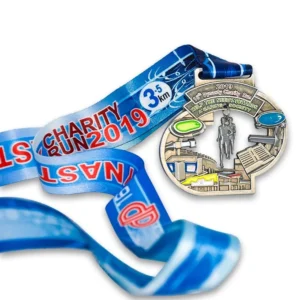
Community and charity runs. For 5K, 10K, and fundraising events, the medal needs to communicate the cause as clearly as the race. A design built around the charity’s emblem and message works harder than a generic running silhouette — see our charity run medals design guide for how fundraisers structure that design.
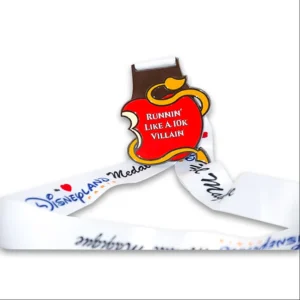
Branded fun runs and corporate events. When the race is built around a company or a mascot, the medal becomes a piece of brand collateral. A shaped design that follows the logo’s outline reads far better at small scale than a circle with the logo dropped into the centre — this is the approach behind the apple shape running medal.
Marathon and half-marathon finishers. For the flagship distance, weight and finish carry the prestige. A substantial medal with a clean, legible finish and a ribbon that names the distance and year is the standard configuration — the charity run sports medal is a good reference for how a clear central emblem plus engraved rim reads at full size.
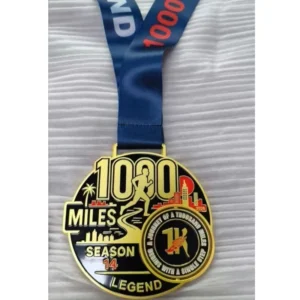
Milestone and ultra clubs. For 100-mile finishers, 1000-mile clubs, and multi-year streaks, a moving element makes the achievement tactile. A rotating centre lets the medal carry two messages — the event on one face, the milestone on the rotating disc — which is how the 1000 miles legend spinning medal is built. For how these are structured across other achievement programs, see our guide to custom spinning medals.
Timing Your Order Around Race Day
Production typically runs 2–4 weeks after design approval, and that clock starts only once the artwork is signed off. Working backwards from race day, budget time for:
- Design and proofing. You will receive a digital mockup showing the medal face and the ribbon before anything is produced. Getting your logo into vector form early removes the biggest source of delay.
- Sample approval. A production sample confirms plating colour, relief depth, and ribbon print. Build in a round of feedback here rather than at the finish line.
- Production. The 2–4 week window above, which varies with quantity and complexity.
- Delivery. Bulk shipping to your race location, or split shipments if you are distributing medals across a multi-city series.
If your race date is fixed — and for a marathon it always is — the safest move is to lock the medal design several weeks ahead rather than matching the order to the race. October and November races are also competing for the same factory capacity, so earlier orders get more scheduling flexibility.
How to Brief a Medal Supplier
A short, complete brief gets you a usable mockup on the first pass:
- Vector artwork (AI, PDF, or SVG). If your logo only exists as a JPG or PNG, your supplier can redraw it.
- Diameter and thickness, or a reference medal you like.
- Plating: gold, silver, bronze, antique, or two-tone.
- Ribbon: colour, printed text, and whether you need safety-release hardware.
- Quantity and deadline, including the date the medals must be in hand.
- Personalization: whether individual names, bibs, or finish times are required, and how that data will be supplied.
- Packaging: pouches, boxes, or bulk.
Every order from our factory includes design support and digital proofs, so you can see the medal before it is struck.
FAQ
What is the minimum order quantity for custom race medals? MOQs vary by design, size, and finish. Send us your quantity and we will confirm what is possible for your budget.
How long does production take? Typically 2–4 weeks after design approval, depending on quantity and complexity. Tell us your race date and we will plan the schedule around it.
Can each medal be personalized with the runner’s name and finish time? Yes. Engraved name, bib number, and finish time are all available; supply the finisher list in a spreadsheet and we will match the format to the medal.
Can you match our race branding on the ribbon? Yes. Ribbon colours and printed text can follow your event palette, and logos can be reproduced on the ribbon as well as the medal.
Do you ship medals in bulk to the race location? Yes — medals can ship to your race venue, your warehouse, or split across multiple pickup points for a race series.
We have never ordered custom medals before. Where do we start? Send your logo, the race date, and a rough quantity. You will get a free digital mockup before any production commitment.
Ready to Order Your Race Medals?
Marathon season waits for no one. Email our design team at a48175901@gmail.com with your logo, quantity, and race date for a free mockup and quote — we will map the production timeline backwards from your event day.